Adenosine:
Adenosine, the decrease in dopamine, a negative side effect of distraction.
Avoid the future reduction in dopamine!
Moments of motivation
Night can increase motivation (which is free, released in the form of dopamine). For example, you have an idea during the night — ‘I am going to write a book’. The next day, you have to get to work: this takes energy, but motivation is then stronger.
Doing a simple activity, such as playing a video game, seems easy, and motivation can become exponential.
Thoughts in the shower are particularly interesting, because the absence of distractions encourages concentration.
In the presence of distractions — smartphones, gadgets, apps — motivation collapses and dopamine disappears.
When can motivation grow?
In calm situations, such as in bed, in the shower or on a walk in nature, motivation can grow. These moments induce an altered state of consciousness, conducive to motivation and productive work.
Every source of distraction has a high dopamine cost. The accumulation of adenosine lowers your dopamine level: you then leave the dopamine ‘train’ and enter a cycle of fatigue and demotivation.
Meditation establishes a state in which dopamine consumption is balanced with adenosine consumption. Your mind becomes free to think, create and reveal itself. It can then explore profound ideas and give free rein to its imagination.
Physical grounding and bodily balance, without excessive energy expenditure, allow the mind to free itself: thoughts flow, then motivation emerges.
Learning to avoid adenosine spikes and dopamine drops gives you genuine mental space, a moment to reconnect with yourself.
‘During the first hour of the day, do not use any technology.’
Behavioural change arises from understanding, observation and experience; it does not happen simply through the exchange of information.
When you depend on games and gadgets, observe yourself: enough of this dependence! As soon as your material success rests on your dopamine reserves — through the dopaminergic circuit of the nucleus accumbens — you expose yourself to failure.
It is easy to fall asleep when you are tired, but staying awake, attentive and motivated is far more rewarding.
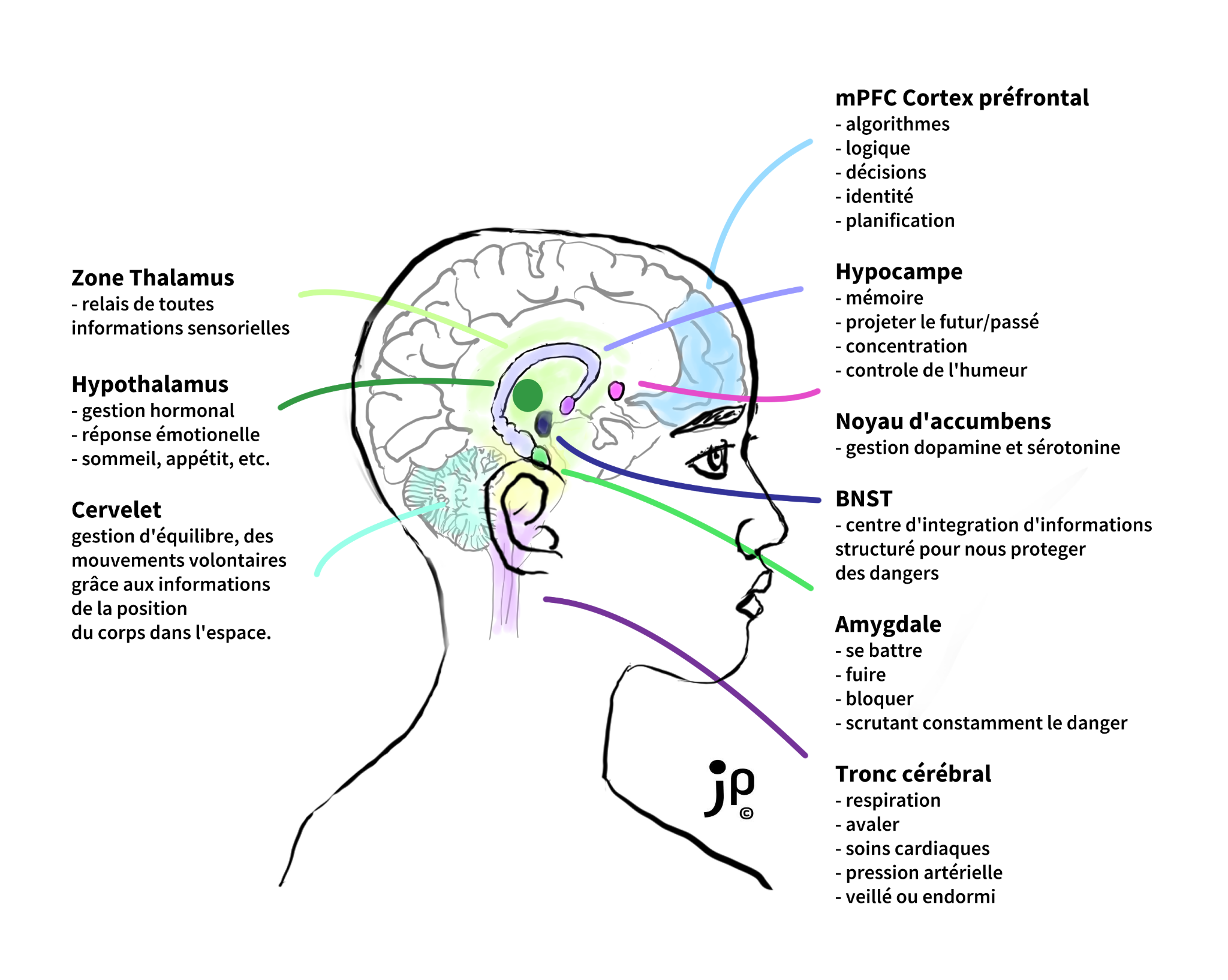
The nucleus accumbens is a brain region central to the reward circuit and the mechanisms of drug addiction. It is a bilateral structure, present in both the right and left hemispheres.
Also called ‘nucleus accumbens septi’ (literally ‘nucleus adjoining the septum’), these nuclei consist of clusters of neurons nestled in the rostral part of the forebrain. They play a major role in the reward system, addiction (habituation and dependence), as well as the emergence of laughter, pleasure, fear and the placebo effect.
Each hemisphere has its own nucleus accumbens, positioned at the junction of the tip of the caudate nucleus and the anterior portion of the putamen, just outside the globus pallidus. Together with the olfactory tubercle, it forms the ventral striatum, one of the components of the basal ganglia.
Two subregions are distinguished within the nucleus accumbens: the ‘core’, corresponding to the dorsal part, and the ‘shell’, corresponding to the ventral part. These two areas differ in both morphology and function.
The nucleus accumbens plays an essential role in regulating dopamine in the brain. In people with AD(H)D, one or the other (or both) of these nuclei functions atypically, resulting in an irregular distribution of dopamine.
When an impulse drives you towards dependence — whether on a game, a habit or any other fixation — it is like a snake casting a spell over you: it seizes you, squeezes you, puts you under pressure, fights your will and forces you to give in to what you no longer wish to do. This is the grip of the need for dopamine, the evidence of addiction's power.
The solution begins with interrupting this pressure for at least an hour. Take a shower, go out for a walk, detach yourself from everything to relieve the mental tension: do not think about a long list of tasks, focus only on the coming hour. Ask yourself: ‘What am I going to do in the next hour?’ ‘What is the best next step?’
Ask yourself this question again and again: ‘What is the most appropriate next action?’
Open the door, walk to the station, take the train on foot or by bicycle. In this movement, you leave dependence and mental pressure behind. The act of going out is sometimes enough to silence that inner voice driving you towards addiction. It is not complicated, and as soon as you have chosen the best action, follow it through.
This is your form of meditation: continually ask yourself about the next step, the best thing to do, drawing on your abilities and will. Music can also help you escape this spiral and enter a calmer state of mind.
To break away from the dopamine ‘train’, change your surroundings, even within your work or gaming environment. Switch to ‘work mode’: distance yourself from anything that creates dependence or distraction — Twitter, TikTok, Instagram and other social networks — and arrange an uncluttered workspace. Use your motivation to set clear boundaries. Clean, cook, tidy and organise your home: an orderly space helps break the cycle of dopamine addiction.