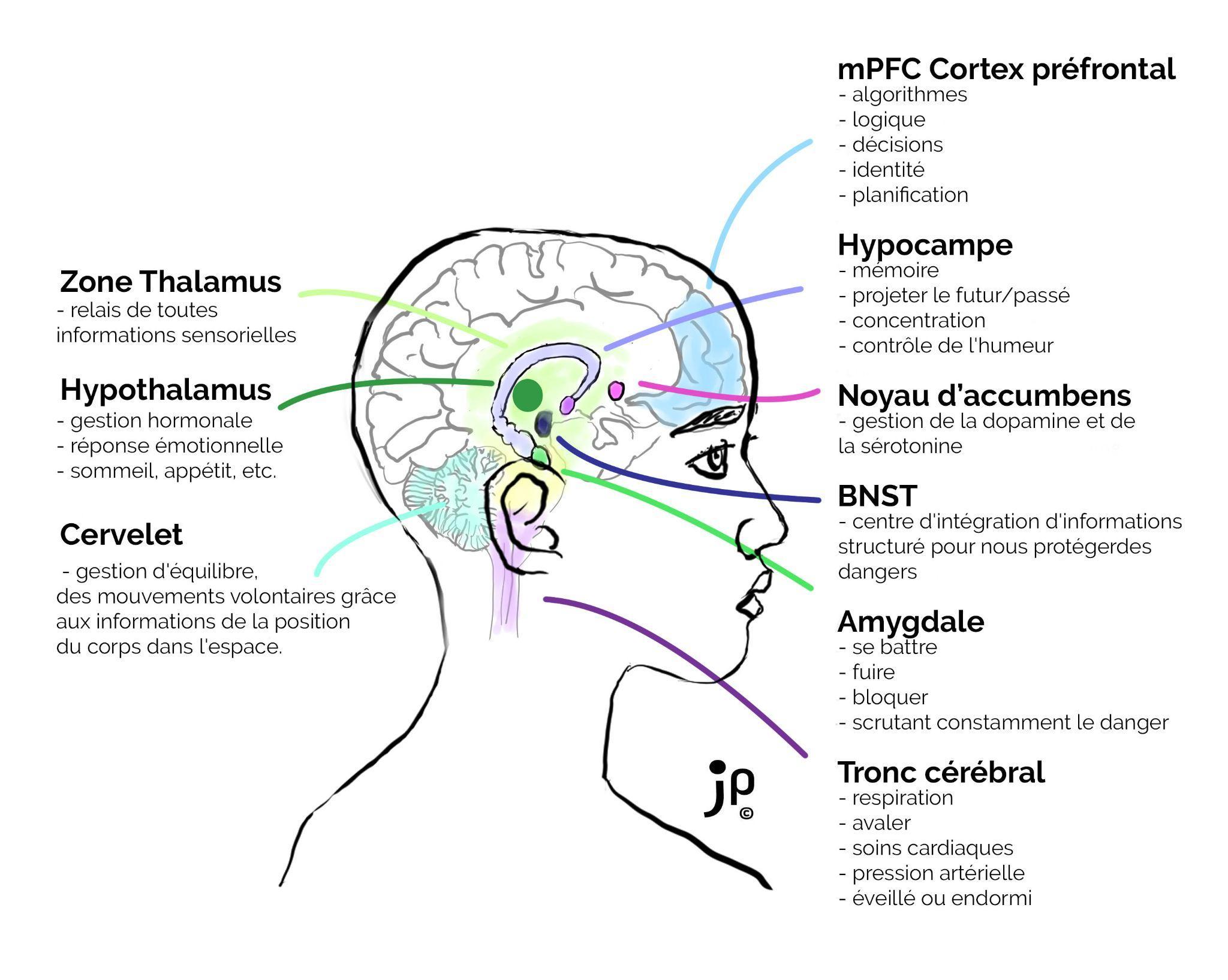
The control and protection centres of our brain
Amygdala
The amygdala triggers rapid fear responses and sends us abrupt warning signals in the face of immediate danger.
Bed nucleus of the stria terminalis (BNST)
The BNST acts as a centre for integrating emotional information. Often called the ‘extended amygdala’, it is located in the oldest part of the brain and consists of 12 to 18 substructures. Its main role is to monitor emotional ‘valence’ (that is, whether a situation is perceived as positive or negative) and protect us from potential threats.
Medial prefrontal cortex (mPFC)
The medial prefrontal cortex processes information, focuses our attention and filters incoming data. It can detect more diffuse or long-term dangers and modulate our emotional responses.
The duel between the mPFC and the BNST/amygdala
Anxiety can be seen as a battle between the medial prefrontal cortex and the BNST-amygdala pair. When the mPFC loses this ‘duel’, emotional alarm signals take over and anxiety becomes difficult to control. Conversely, when the mPFC wins, we manage to regulate our fears and remain calm: this is sometimes called the ‘blue zone’ of emotional control.
Breathing techniques
When we remain still or stressed, stale, oxygen-depleted air can stagnate in the throat and lungs. To stay healthy, it is essential to renew this air regularly.
This is called three-phase breathing because fresh air follows three successive pathways:
1. Diaphragmatic (abdominal)
○ Breathe in slowly, inflating your belly like a balloon.
○ Breathe out while drawing your belly in.
2. Thoracic
○ Focus on expanding the rib cage.
○ Raise your shoulders slightly as you breathe in.
3. Clavicular
○ Finally, gently raise your collarbones to complete the filling of your lungs.
It is normal to feel slightly light-headed during the first sessions: it is a sign that oxygenation is taking place optimally.