Freedom and AS
To attain freedom, we must first become aware of our prison. We all aspire to freedom, whatever our age. The person with AS, an independent thinker, constantly fights for theirs. That freedom is often hindered by both physical and psychosocial obstacles. The wall of anxiety is immense, the incompatibility with society overwhelming, and physiological challenges demand discipline at every moment.
These are some of the obstacles to freedom. The best way to free ourselves is first to visualise our inner prison: detach ourselves, one by one, from the emotional bars, fears and social prejudices. Becoming aware of these chains, exercising our will to loosen them gradually, anchoring ourselves in our centre of well-being and inner peace, identifying with our soul… this is the path towards becoming one with ourselves and leaving our own prison.
Our ideas are an integral part of our identity. If I identify completely with my convictions, I will constantly fear being shown that they are false or contradictory, and I will argue endlessly with anyone who questions them. Even if my ideas are outdated, incomplete or contradicted by the facts, I will cling to them and continue to defend them — because my belonging to the group, or even my existence, depends on it!
For a person with AS, it is different: they defend their ideas passionately, but without confusing them with their own identity. Distancing ourselves from our thoughts can be a great help. If we identify 100% with our beliefs, we risk making them rigid. By contrast, letting go of preconceived ideas and old mental habits can stimulate our imagination and broaden our horizons. Knowing how to disidentify opens up our field of vision, makes us freer and more dynamic, and releases us from the tyranny of a single way of thinking.
We then return to the pivot of our being, that unchanging part within each of us: the “I”, present throughout our lives. Whether in joy or sorrow, childhood or old age, success or failure, this same “I” persists. Discovering this vital core is essential, because it is where our inner strength resides.
Unlike an allistic person, a person with AS does not have a fixed identity, but can find this centre of inner strength. They do not seek to build a strong outward identity, except perhaps when they enjoy performing as an actor or actress — and there are excellent actors with AS.
There is nothing wrong with living everything life offers intensely, provided we remain aware that this is not all that exists. Find your centre! This centre is also the best remedy for stress.
We can act on stress in two ways:
1. From within: if I am tense, I learn to relax; if I am short of breath, I learn to breathe deeply; if my thoughts torment me, I replace them with soothing thoughts.
2. By stepping back: I see that I am not my stress, and I reconnect with that part of me where peace reigns.
The “centre” is that place of calm, away from fears and turbulence. On Sundays, we practise disidentification — but not the person with AS! For them, every day is a quest for unity with the Self and the Soul, founded on a sincere desire of the heart. The person with AS takes no time off: at every moment, they pursue harmony and well-being.
Why does a person with AS find it difficult to manage their emotions and thoughts? Because their prefrontal cortex — that great manager of information — develops more slowly and requires more time and stimulation than average to mature.
This is where certain parents come in, guided by genuine “intelligent love”: from early childhood, they actively support their child. This personal investment — sacrifice of time and energy, priority and the intention to do well — bears fruit a thousand times over.
This support takes several forms:
● Connection: responding to the child’s invitation and entering their world;
● Stimulation: offering options without imposing them;
● Sensory awakening: introducing the child to music, singing and sound games.
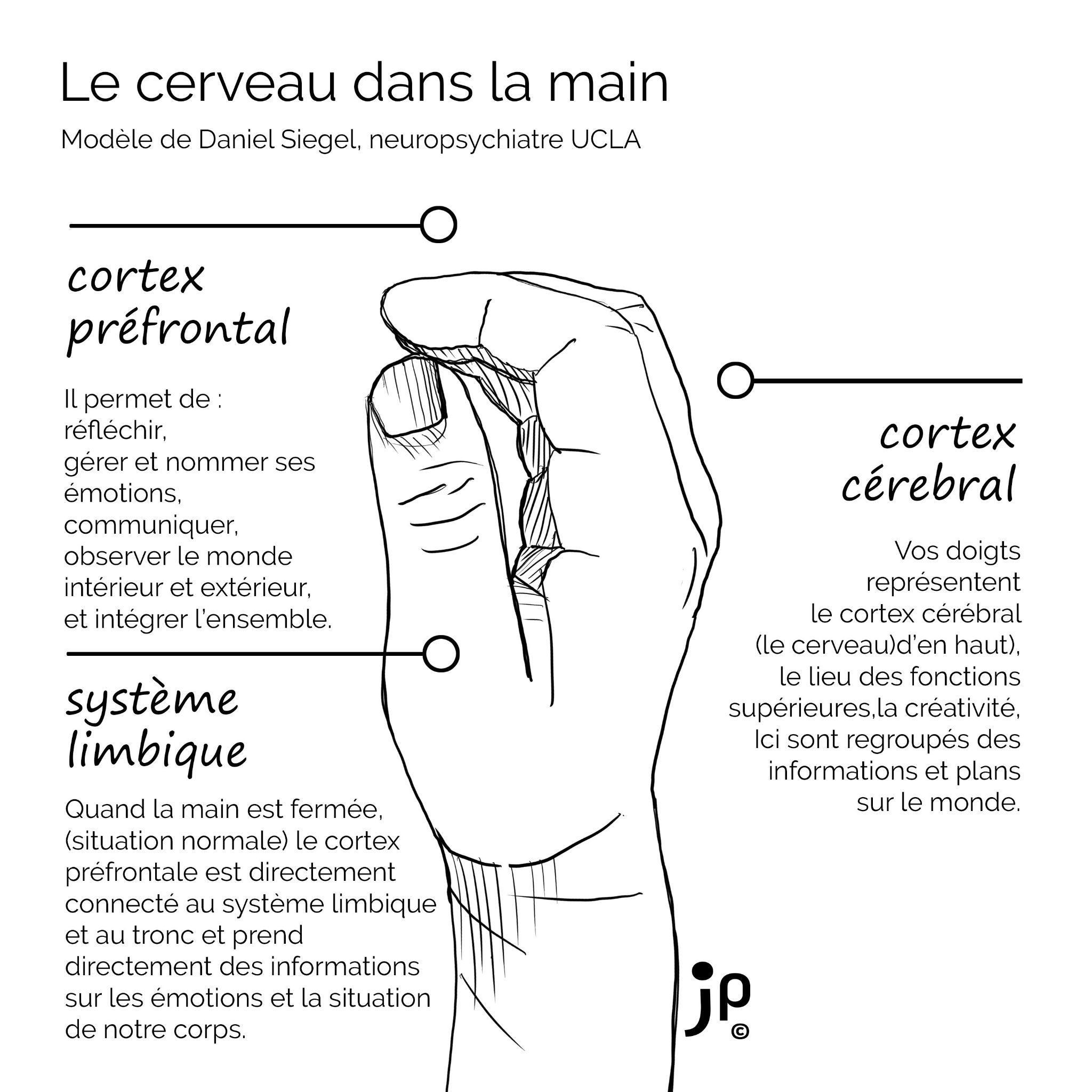
Learning to use “the brain in the hand” helps us regulate our reactions better and step back from the overwhelming processes of our mind. Interpersonal neurobiology encompasses all the sciences of the brain and body: it reminds us that technology must remain a tool at our service, not the other way round. Above all, it is relationships that stimulate our growth and foster learning!
The brainstem, an ancient structure already formed in the womb, keeps us awake and alert; it triggers defensive reactions — fight, flight, freeze — or sometimes a total collapse, as often happens to people experiencing overload.
The limbic area, also present before birth, works with the brainstem to generate our emotions and record memories. It also allows us to feel a connection with others.
The cortex, meanwhile, develops through our experiences. Its posterior part maps the outside world, while the frontal cortex enables reflection and decision-making. The underside of this cortex contributes to managing and evoking our emotions. This is where self-awareness arises: the ability to observe our thoughts and feelings, and adjust the flow of information within us, including the way we communicate.
At the heart of the prefrontal cortex, right beside the limbic area and directly connected to the brainstem, the central part processes emotional information very quickly. Here we see the anatomical proximity of the three major systems: cortex, limbic system and brainstem — hence the image of the brain in the hand.
The frontal cortex can even perceive the emotions of others: facial blushing is one example. This ability is one of the keys to relationships. In autism spectrum disorder, the issue is not so much detecting information as managing it within a given context. Autistic people may perceive a multitude of signals yet have difficulty organising and interpreting them.
Our relationships with others
The frontal part of the brain integrates information from our heart, every corner of our body and the brain itself, adding information from our interactions. When you think about a person or the quality of your relationship — communication, attention, connection — you engage what is called the “integrative relationship”.
Maintaining attentive, connected relationships strengthens your brain’s “integrative fibres”, meaning the neural connections that make you more resilient in the face of hardship. This integrative stimulation allows you to think about the common good — including the future of the planet — develop your intuition, place your past, present and future in perspective, and connect with others.
All of this is built by cultivating inner reflection and learning to evoke and manage our emotions. Supportive relationships, such as those offered by parents and teachers, play a decisive role in this development; they make reflection, relationship and resilience — the three “R”s — the foundations of a frontal cortex that remains active and continues to mature, even in children.
Parents are, above all, their children’s first educators: it takes three to four years for the circuits of kindness and benevolence to become firmly established. Science does not yet have an operational definition of the mind; this is why it is essential to use your relationship with your child to reframe and strengthen their mind, so that they can adapt harmoniously to their environment.
Understanding how the brain works allows us to transform it: you are not your brain, you are so much more! Building a strong bond with your child is by far the most important element of parenting. First learn to connect; only then, once that bond is established, can you reason together.
The mind is not reducible to brain activity: through your intention, you can stimulate your cultural development. Mindfulness is a method of neural integration; the relationships between mind and brain are built step by step.
What is self-regulation? It is the ability to make feelings, thoughts and emotions manageable. Reflection, relationship and resilience form the basis of social intelligence. Children can learn to name their emotions to manage them better: this ability then allows them to understand others.
By first developing kindness and compassion towards themselves, they acquire the foundations needed to show them towards others. When we help others, we release dopamine and feel joy: if you want to be happier, think of others.
When your child is going through inner turmoil, with emotions and thoughts swirling around, do not give in to authoritarianism by ordering them to “be quiet” or “stop screaming”. Do not immediately try to reason; first choose caring contact: place your hand, where they can see it, on their arm or shoulder, with the sincere intention of reassuring them. Once they have calmed down, you can then talk and reason together.
That said, always respect their space: never touch a child without being invited to do so. Your role is to support this child in structuring and understanding their world, creating a climate of openness and calm. Once this approach becomes second nature to you, you will have more than earned a medal!
A simple breathing exercise
Sit comfortably, close your eyes and breathe deeply through your nose, without forcing it. When your mind wanders, gently bring your attention back to your breath. Be fully aware of every inhalation and exhalation. “In everyday life, well-being is only a few breaths away!”
Occupational therapy and sensory stimulation
Occupational therapy aims to engage and regulate the different senses to promote appropriate brain processing. “Sensory programmes” are offered throughout the day to:
● Sensitise or desensitise you to noises and textures
● Harmonise your reactions to different situations
● Control your breathing and refine your fine motor skills
● Gradually accustom you to auditory stimuli. The aim is to become more independent and better manage the intense reactions caused by disturbing impressions.
Music therapy
Music therapy uses music to express and explore emotions. You become familiar with:
● Rhythms
● Timbres and sounds
● Melodies, to develop your emotional language and your ability to communicate through sound.
Dietetics
To balance blood sugar and promote well-being:
● Reduce wheat, refined carbohydrates and casein
● Limit fruit late in the day, and lactose
● Favour vegetables (preferably organic) and quality proteins
● Avoid sweets and processed foods
● Prepare your own meals if possible. A balanced “food triangle” of vegetables – proteins – starchy foods is a simplified approach to keeping control of your diet (see the chapter “Dietary disorders” for more details).
Speech and language therapy
Speech and language therapy allows you to work on:
● Pronunciation and articulation
● Sound production
● Verbal expression and communication
An approach using primitive reflexes
Primitive reflexes are automatic movements present from life in the womb and active for several months after birth. They develop in three phases:
1. Emergence
2. Activation
3. Integration
If this progression is disrupted, it can lead to postural, learning or behavioural difficulties. Specific techniques now make it possible to stimulate or integrate these reflexes, thereby helping to rebalance the brain, build neural connections and repair the brain’s matrix.
Excerpt from the website of Caroline Llonch, a certified IMP practitioner trained in RMT (Rhythmic Movement Training).
Brain Gym® — literally “gymnastics for the brain” — consists of 26 basic movements that are simple, precise and playful, designed to optimise learning and performance in all areas. Originating in Educational Kinesiology®, this programme draws on the close link between body movements and brain functions involved in neurodevelopment, learning and perception. By combining movement with listening to the body, it offers everyone the opportunity to explore and fully develop their potential.
— Excerpt from the website of Caroline Llonch, a certified Educational Kinesiology® practitioner and Brain Gym® instructor
Rediscovering inner peace
To reach a state of calm, ease your nervous system and recharge your batteries, several approaches are possible: meditation, yoga, mindfulness, physical activity, music. Artistic expression — whether through visual arts, drawing or making music — encourages beneficial time alone in your own bubble, as does attentive listening to a melody. Video games, on the other hand, although they offer a temporary refuge, can lead to dependency and counterproductive results over the long term. Thus, one (art) proves constructive, while the other (video screens) tends to be destructive and addictive.
Sport, walking, dancing and singing remain essential pillars for releasing tension. A few yoga or tai chi exercises are sometimes enough to transform a day: learning to release nervous tension, recharge your batteries and lighten the mind of excessive impressions, to adapt better to different moments and situations.
Cognitive behavioural therapy (CBT)
When an autistic person feels threatened in their integrity and unable to cope with a situation, they may experience an extreme panic reaction, or even a general breakdown of bodily functioning (a catastrophic reaction). CBT allows unhelpful patterns of thought and reaction to be analysed, followed by learning new mental and behavioural strategies to manage crises better.
Here is a proposed rewrite in polished French, respecting the meaning of the text:
Keywords in the world of the autism spectrum:
● processing speed and recognition of emotions
● communication cues
● social interference
● empathy
● reading and understanding non-verbal body and facial language
● “pre-messages” and “pre-definition” of available information
● verbal messages that slip under the radar
● managing expression
● dysfunctional cognition and understanding
● linguistic flexibility needed to meet social demands
● expectations
● emotional regulation
● control of internal perceptions
Allistic thinking and the organisation of the school system are often at the root of crises.
“I impose my will on you so that you become exactly what I want.”
An imposed framework generates crises, tension, exhaustion and depression. Conversely, a freely chosen activity arouses attention and desire, encourages the child’s active engagement, offers immediate feedback (allowing continual adjustment) and, through repetition, leads to genuine learning.